About admin

    Solo si concurre una causa legal concreta prevista en el Código Civil; «no quiero dejarle nada» o «llevamos años sin hablarnos» no es, por sí solo, motivo suficiente, y una desheredación sin causa real puede ser anulada por el hijo desheredado.

    Las causas legales para desheredar a un hijo

    El artículo 853 del Código Civil recoge dos causas específicas:

    1. Negarle alimentos, sin motivo legítimo, al padre o ascendiente que le deshereda.
    2. Maltratarle de obra o injuriarle gravemente de palabra.

    A estas se suman las causas generales de indignidad (por remisión al art. 756 CC): haber atentado contra la vida del testador o de sus familiares cercanos, haberle acusado falsamente de un delito grave, o haberle obligado mediante fraude o violencia a hacer o cambiar el testamento.

    El matiz que casi nadie explica bien: el maltrato psicológico

    Desde 2014, el Tribunal Supremo interpreta que el «maltrato de obra» no se limita a la agresión física: también incluye el maltrato psicológico grave (menosprecio, vejaciones, abandono afectivo severo hacia el ascendiente). Esto ha permitido desheredar en casos donde no hubo violencia física pero sí un daño psicológico real y probado.

    Pero cuidado con un error muy extendido: en 2022 (STS 419/2022), el Tribunal Supremo dejó claro que el simple distanciamiento o la falta de relación entre padre e hijo no es, por sí sola, causa de desheredación. Solo lo es cuando ese distanciamiento es imputable al hijo y equivale, en la práctica, a un verdadero maltrato psicológico probado. «Hace años que no me llama» no es lo mismo que «me ha causado un daño psicológico grave y demostrable», y confundir ambas cosas es la razón más habitual por la que una desheredación acaba anulada.

    Requisitos para que la desheredación sea válida

    • Debe hacerse expresamente en testamento, indicando la causa concreta en la que se basa. Una desheredación declarada en cualquier otro documento no es válida.
    • La causa debe ser cierta: si el hijo la niega, la carga de probarla recae en quien defiende la desheredación (normalmente, los demás herederos).

    Qué pasa con los nietos si desheredas a un hijo

    Este es un punto que se suele pasar por alto: desheredar a un hijo no deshereda automáticamente a sus propios hijos (tus nietos). El artículo 857 del Código Civil establece que los hijos o descendientes del desheredado ocupan su lugar y conservan los derechos de herederos forzosos sobre la legítima. Si de verdad quieres que la desheredación afecte también a los nietos, hay que desheredarlos a ellos también, expresamente y con su propia causa.

    Si el hijo desheredado impugna

    Una desheredación se considera injusta, y puede anularse, si se hizo sin expresar causa, o alegando una causa que luego no se logra probar. Por eso conviene que el testamento no se limite a mencionar el artículo aplicable, sino que describa con claridad los hechos concretos en los que se basa.

    Preguntas frecuentes

    ¿Puedo desheredar a un hijo solo porque no tengo relación con él?
    No, salvo que ese distanciamiento sea imputable a él y equivalga a un maltrato psicológico real y demostrable. La falta de relación por sí sola no es causa legal.

    ¿Qué pasa si desheredo sin motivo válido?
    La desheredación se considera injusta y puede ser anulada si el hijo la impugna, recuperando este su derecho a la legítima.

    ¿Si deshereda a mi hijo, sus hijos (mis nietos) pierden también la legítima?
    No automáticamente. Ocupan el lugar de su padre y conservan el derecho a la legítima, salvo que también existan causas de desheredación contra ellos.

    ¿Puedo desheredar simplemente indicando el artículo del Código Civil sin más explicación?
    No es recomendable: si el hijo lo impugna, hay que probar los hechos concretos, no solo citar la ley.

    ¿Puedo resolver esto con una plantilla de internet o preguntándoselo a una IA?
    No es recomendable. Ni una plantilla genérica ni una respuesta de inteligencia artificial pueden anticipar las consecuencias legales y fiscales concretas de tu patrimonio y tu situación familiar: cada caso debe revisarse en detalle, con un profesional, antes de tomar una decisión.

    La legítima es la parte de tu herencia que la ley reserva obligatoriamente a determinados familiares (herederos forzosos), de la que no puedes disponer libremente ni siquiera haciendo testamento. Si el testamento no la respeta, quien se vea perjudicado puede reclamarla.

    Quiénes tienen derecho a la legítima

    El artículo 807 del Código Civil establece un orden de herederos forzosos:

    1. Hijos y descendientes, respecto de sus padres y ascendientes.
    2. A falta de los anteriores, los padres y ascendientes, respecto de sus hijos y descendientes.
    3. El cónyuge viudo, en la forma y medida que establece la ley (siempre en usufructo, nunca en propiedad, y solo si concurre con los anteriores u ocupa su lugar).

    Solo se pasa al segundo grupo si no hay descendientes, igual que en la sucesión sin testamento.

    La legítima de los hijos: dos tercios de la herencia

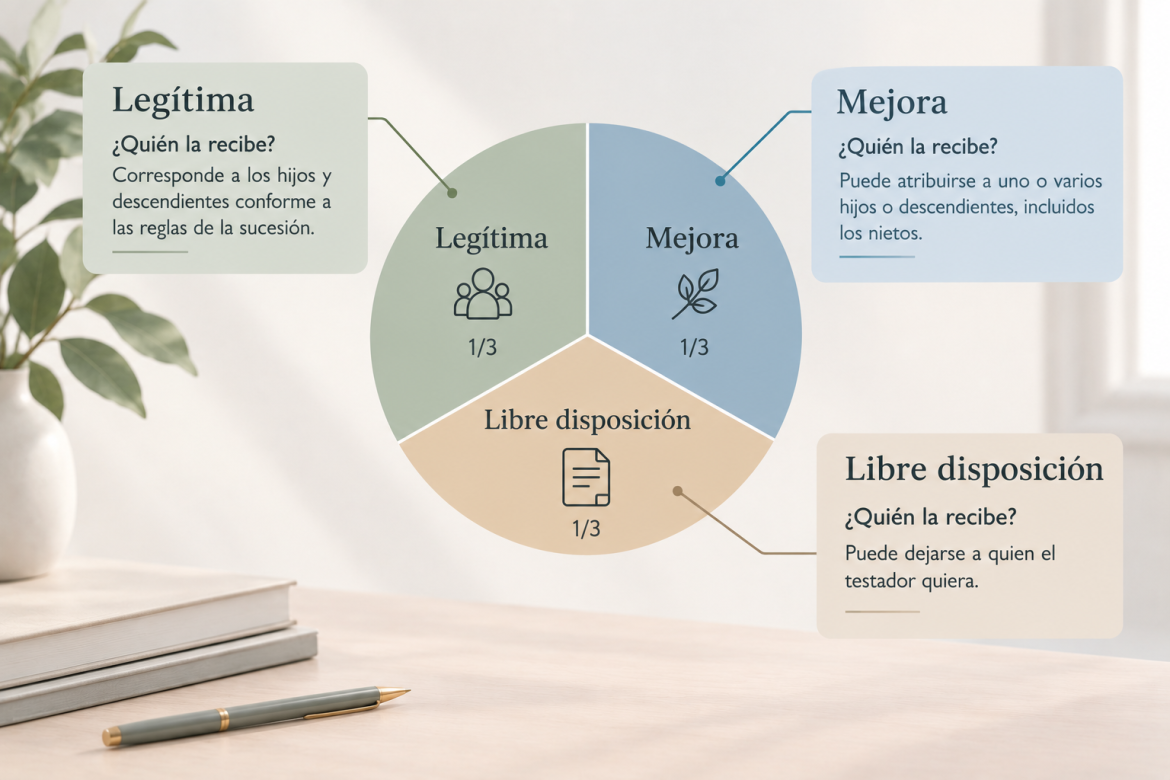
    Según el artículo 808 CC, la legítima de los hijos y descendientes son dos terceras partes de la herencia, que a su vez se dividen en dos conceptos:

    • Un tercio de legítima estricta: debe repartirse a partes iguales entre todos los hijos, sin que el testador pueda favorecer a unos sobre otros.
    • Un tercio de mejora: también es legítima, pero el testador puede repartirlo de forma desigual entre sus hijos o descendientes (por ejemplo, dar más a uno que a otro), o incluso dárselo todo a uno solo. Además, el tercio de mejora puede atribuirse directamente a un nieto, aunque su padre o madre (hijo del testador) siga vivo.

    El tercio restante es de libre disposición: el testador puede dejarlo a quien quiera, sea o no heredero forzoso.

    La legítima de los padres y ascendientes

    Solo entra en juego si no hay hijos ni descendientes. Según los artículos 809 y 810 CC:

    • Si no concurre cónyuge viudo, la legítima de los ascendientes es la mitad de la herencia.
    • Si concurre con el cónyuge viudo, se reduce a un tercio.

    La legítima del cónyuge viudo

    Como se explica en la pieza sobre herencia sin testamento, la legítima del cónyuge viudo es siempre en usufructo (nunca en propiedad) y varía según con quién concurra: un tercio si hay hijos, la mitad si solo hay ascendientes, y dos tercios si no hay ni lo uno ni lo otro.

    Qué pasa si el testamento no respeta la legítima

    Si un testamento perjudica a un heredero forzoso por debajo de lo que legalmente le corresponde, este puede ejercitar la acción de reducción de disposiciones inoficiosas (arts. 815 y siguientes CC) para que se reduzcan las donaciones o legados que excedan de la parte de libre disposición, hasta completar su legítima.

    Preguntas frecuentes

    ¿Puedo dejar toda mi herencia a una sola persona?
    Solo si no tienes herederos forzosos (hijos, descendientes, o en su defecto padres/ascendientes, y cónyuge). Si los tienes, la ley te obliga a reservarles su legítima.

    ¿Qué pasa si mi testamento no respeta la legítima?
    El heredero perjudicado puede reclamar mediante la acción de reducción, que ajusta lo recibido por otros para completar su parte.

    ¿Puedo repartir el tercio de mejora como yo quiera entre mis hijos?
    Sí, es la parte pensada precisamente para eso: puedes favorecer a un hijo sobre otro, o incluso dejárselo directamente a un nieto, algo que no puedes hacer con el tercio de legítima estricta.

    ¿La pareja de hecho tiene legítima?
    No. La legítima del cónyuge solo corresponde a quien esté casado con el fallecido, no a la pareja de hecho.

    ¿Puedo resolver esto con una plantilla de internet o preguntándoselo a una IA?
    No es recomendable. Ni una plantilla genérica ni una respuesta de inteligencia artificial pueden anticipar las consecuencias legales y fiscales concretas de tu patrimonio y tu situación familiar: cada caso debe revisarse en detalle, con un profesional, antes de tomar una decisión.

    Si no hay testamento, la ley decide quién hereda. Te explicamos el orden exacto: hijos, ascendientes, cónyuge y colaterales.

    Si una persona fallece sin testamento, la ley decide quién hereda y en qué proporción, siguiendo un orden fijo: primero los hijos y descendientes, después los padres y ascendientes, después el cónyuge viudo, y por último los hermanos y otros parientes colaterales. Este reparto legal se llama sucesión intestada o «ab intestato», y se tramita mediante una declaración de herederos ante notario.

    El orden de la sucesión intestada

    El Código Civil (arts. 930 a 958) establece un orden de llamamientos que se aplica en cascada: solo se pasa al siguiente grupo si no hay nadie del grupo anterior.

    1. Hijos y descendientes. Heredan a partes iguales; si un hijo ha fallecido antes, su parte pasa a sus propios hijos (los nietos del fallecido), por derecho de representación.
    2. Padres y ascendientes. Solo heredan si no hay hijos ni descendientes.
    3. Cónyuge viudo. Si no hay descendientes ni ascendientes, el cónyuge hereda en pleno dominio (la propiedad completa, no solo un usufructo).
    4. Hermanos y sobrinos, y a falta de ellos, otros parientes colaterales hasta el cuarto grado.
    5. El Estado, si no hay ningún pariente con derecho a heredar.

    Qué recibe el cónyuge viudo (y por qué no es siempre lo mismo)

    El cónyuge viudo tiene un tratamiento especial: nunca queda fuera, pero lo que recibe cambia según con quién concurra:

    • Si hay hijos o descendientes: el cónyuge tiene derecho al usufructo de un tercio de la herencia (el llamado «tercio de mejora»); la propiedad de ese tercio, y el resto de la herencia, es para los hijos.
    • Si no hay descendientes pero sí ascendientes (padres del fallecido): el cónyuge tiene derecho al usufructo de la mitad de la herencia.
    • Si no hay ni descendientes ni ascendientes: el cónyuge hereda en pleno dominio, como único heredero.

    Este usufructo se puede sustituir, si hay acuerdo entre el cónyuge y los demás herederos, por una renta vitalicia, el producto de determinados bienes, o un capital en efectivo.

    Un caso frecuente: la pareja de hecho

    A diferencia del cónyuge, la pareja de hecho no hereda automáticamente si no hay testamento, por muchos años de convivencia que existan. La sucesión intestada solo reconoce derechos al cónyuge por matrimonio. Si quieres que tu pareja de hecho herede, la única forma de garantizarlo es hacer testamento.

    Si hay hijos de distintas relaciones

    Todos los hijos heredan por igual, sin distinción según de qué relación provengan; la sucesión intestada no hace esa diferencia.

    Cómo se tramita

    Cuando no hay testamento, los herederos deben solicitar una declaración de herederos abintestato ante notario, aportando certificado de defunción, certificado de últimas voluntades y el libro de familia o certificados de nacimiento que acrediten el parentesco. Solo con esa declaración se puede después repartir la herencia.

    Preguntas frecuentes

    ¿Hereda mi pareja de hecho si no tenemos testamento?
    No. La sucesión intestada solo reconoce derechos al cónyuge por matrimonio; sin testamento, tu pareja de hecho no hereda nada por esta vía.

    ¿Qué pasa si no tengo hijos ni padres vivos?
    El cónyuge viudo hereda en pleno dominio, como único heredero, sin necesidad de compartir la propiedad con nadie más.

    ¿Puede un nieto heredar si su padre (hijo del fallecido) ya ha muerto?
    Sí, por derecho de representación: el nieto ocupa el lugar de su padre y recibe la parte que a este le habría correspondido.

    ¿Es necesario ir a juicio para repartir una herencia sin testamento?
    No, salvo que haya desacuerdo entre herederos. Lo habitual es tramitarlo todo ante notario.

    Ending a marriage, with grace and respect

    Artículo de Esther Perel, publicado hace ya muchos años, pero que sigue siendo actual. Muy recomendable

    Yes, you can have a successful divorce, says relationship therapist Esther Perel. The first step? Writing goodbye letters to each other.

    Our culture views divorce as a failure, and even more so when it is precipitated by an infidelity. Longevity is seen as the ultimate indicator of marital achievement, but plenty of people who stayed “till death do us part” have been miserable. When a relationship has run its course, I try — when I can — to help it end with dignity and integrity. I see no contradiction in asking a couple about the success of their breakup.

    Take Clive and Jade. I first met them as newlyweds twenty-two years ago, when I led a workshop for mixed-race couples. They were carefree, full of promise. Two decades, three kids, and one affair later, their marriage was on its last legs, and they came to me for help. Clive had recently come clean about his secret relationship with Kyra. He felt terribly guilty but had resolved to move on and make a life with his new love. Jade was desperate, fighting to hold on to him. I remember her hanging on to every word, gesture and smile from Clive, but all of it was in vain.

    Just as we have marriage ceremonies to mark the beginning of a union, we also need rituals to mark the end.

    I felt it was my responsibility to decrypt the message that was right in front of us: “Jade, he’s not coming back. Your sadness makes him feel guilty, and that guilt instantly morphs into anger at you for making him feel bad that he’s making you feel bad. He may not be gone, but he’s not here, either.”

    And I told Clive, “You keep waiting till you can leave without guilt, and that’s never going to happen. It’s time to set her free.” He vacillated between being paralyzed and wanting to run as fast as he could, for fear that if he didn’t bolt, he’d get stuck again. I thought they needed to take the time to say a proper goodbye, so I suggested a separation ceremony.

    Just as we have marriage ceremonies to mark the beginning of a union, we also need rituals to mark the end. A marriage is the nexus of an entire life — history, memories, habits, experiences, children, friends, family, celebrations, losses, homes, trips, holidays, treasures, jokes, pictures. Why throw all of this out and treat the relationship, in the poetic words of Marguerite Yourcenar, like “an abandoned cemetery where lie, unsung and unhonored, the dead whom they have ceased to cherish”?

    Rituals facilitate transitions. They also honor what was. Clive and Jade once exchanged vows; now they are tearing them up. But just because he fell in love with another woman doesn’t mean their entire past together was a fraud. Such a summation is cruel and shortsighted. The legacy of two decades of a shared life is larger than the legacy of the affair.

    Ending a marriage goes beyond the signing of divorce papers. And divorce is not the end of a family; it’s a reorganization.

    When a couple arrives at the finishing line, drained after two years of back and forth — his confusion, her false hopes, his guilt about leaving, her holding on — it’s easy to undervalue what they’re leaving behind. The purpose of the ceremony was to not let Clive’s affair eclipse all the positive aspects of their otherwise good marriage.

    Sometimes, departing spouses are reluctant to shift their focus to the good things in their relationship because they are afraid it will take the wind out of their sails. It’s as if they feel the need to trash what they had, in order to justify leaving. What they don’t realize is that by doing so, they simultaneously degrade their own past and all the people they shared it with — leaving a trail of angry children, parents, friends, and exes.

    We need a concept of a terminated marriage that doesn’t damn it — one that helps to create emotional coherence and narrative continuity. Ending a marriage goes beyond the signing of divorce papers. And divorce is not the end of a family; it’s a reorganization.

    This kind of ritual has caught the public imagination in recent years, dubbed “conscious uncoupling” by author Katherine Woodward Thomas. I invite couples to write goodbye letters to each other: letters that capture what they’ll miss, what they cherish, what they take responsibility for, and what they wish for each other. This allows them to honor the riches of their relationship, to mourn the pain of its loss and to mark its legacy. Even if it is done with a cooled heart, it can nonetheless provide solace.

    When she finished reading her letter, we were all in tears.

    When Clive and Jade came in for the following session, they had their letters on their iPhones. One click and the reading began. Entitled “What I’ll Miss,” Jade’s letter was a ten-page list, divided into categories, wistfully evoking the multilayered tapestry of their history. Their personal sayings — Hola, chickly . . . Dame un beso . . . the baaaaaby. The early days — love notes, mixtapes, salsa and more salsa, dog parks, parking meters, the opera. The food they loved. Their friends. The places that held meaning for them, from Martha’s Vineyard to Paris to the Cornelia Street Café to apartment 5C. Their “sexy spots.” Their “firsts” . . .

    No one else will ever share the particular meanings these everyday things hold for them. She listed the connections she’d miss: “feeling protected, safe, beautiful, loved.” Her final category was simply “You”: “Your scent. Your smile. Your enthusiasm. Your ideas. Your hugs. Your big strong hands. Your balding head. Your dreams. You, next to me.”

    When she finished reading, we were all in tears and there was no need to trample the tenderness with any extraneous verbiage. But it is important for the scribe to hear her own words read back to her, so I asked Clive to do so. Then he read his own pages.

    Hers was a love letter; his, a diplomatic farewell, thanking her profusely for the life they had shared, expressing regret for having fallen short and assuring her that he would always treasure their bond. He was kind and caring, but his tone was purely formal. His opening and closing sentences say as much: “Thank you for being an amazing person and a truly wonderful force in my life over the past twenty-two years” . . . “I want you to know that despite its outcome, I see the good in our marriage, and will always cherish it and hold it deeply within my heart.”

    This cathartic closure proved to be the right ritual for this couple. But sadly, many pairs spew out a long list of curses rather than a list of sweet memories.

    A year later, when I follow up with Jade, she emphasizes how the ritual of uncoupling helped her to see the writing on the wall. “At first I thought it was a little New Age-y, but I was also proud to be doing it and even shared it with some friends. We were doing something right, despite all the wrong that had come before. I often wondered, How is he going to leave? Is he just one day going to wake up, say, ‘Okay, bye,’ and walk out the door? The separation ceremony put an end to my ruminations. I desperately needed a way to help me accept that he loved another woman and it was really over.”

    Some affairs are temporary side stories; others are the beginnings of a new life. Clive’s was the latter, and no amount of waiting on Jade’s part would have changed that. The tone of his letter made that all too clear to her. “It wasn’t a ‘what I’ll miss’ letter,” she says. “It was a ‘we are over’ letter. He said some nice things, but this was definitely a man no longer in love. It struck me right then and there that while I was still suffering, still very much in love, he was gone. It hurt, more than you know, but it opened my eyes.”

    Next, I caught up with Clive, who remembered the ceremony as “emotional and effective.” Guilt was turned into gratitude, denial replaced by memory. Gradually, he was able to simultaneously hold his attachment to Jade and his children and the calling of a new life with Kyra. “Until that moment, it hadn’t felt real. The symbolism gave it a seal of finality.”

    This cathartic closure proved to be the right ritual for this couple. But sadly, many pairs spew out a long list of curses rather than a list of sweet memories. Wherever I can, I try to help people create narratives that are empowering rather than victimizing. It doesn’t always involve forgiveness, it makes room for anger, but hopefully it is an anger that mobilizes rather than keeps them trapped in bitterness. We need to go on with life — to hope again, love again and trust again.